How much does a paver driveway cost in Staten Island?
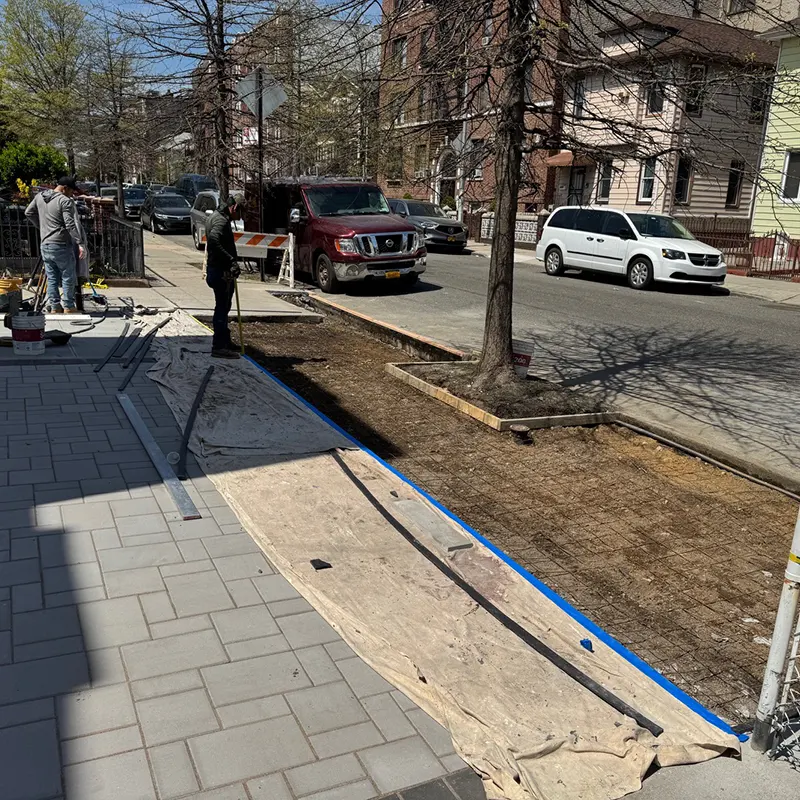
It comes down to the square footage, the paver you choose, how much excavation and base the driveway needs, whether an old concrete or asphalt driveway has to be removed first, and whether the apron needs a DOT permit. A standard single driveway on good ground is a smaller job than a wide driveway that needs demo, drainage, and an apron. We price it on site and give a free written estimate.
Which is better, a paver driveway or a concrete driveway?
Both are good if built right. A poured concrete driveway is lower up-front cost and fully solid, but when it cracks the crack shows and repairs are patchy. A paver driveway costs more up front but flexes with the ground instead of cracking, hides oil stains better across many units, and lets you replace a single damaged paver instead of the whole surface. For looks and long-term repairability, pavers win; for lowest up-front cost, concrete does.
Do paver driveways sink or get ruts?
Only when the base is under-built. Ruts in the wheel tracks are the classic sign of a paver driveway laid on a patio-grade base that cannot spread vehicle load. Built on a deep, properly compacted, load-rated base with herringbone interlock and solid edge restraints, a paver driveway carries daily vehicle weight without rutting.
Can you plow snow on a paver driveway?
Yes. A properly installed paver driveway handles a plow fine. A plastic or rubber-edged blade set slightly high is easiest on the surface, and because the joints are locked with sand, the pavers stay put. Pavers also shed snow and ice well, and unlike asphalt they will not soften or get gouged in the same way.
What is herringbone and why is it used for driveways?
Herringbone is a zig-zag interlocking pattern where pavers lock into each other at 45 or 90 degrees. On a driveway it is the strongest layout because a braking or turning tire spreads its force across many interlocked pavers instead of pushing one out of place. That is why it is the standard pattern for vehicle surfaces.
Are permeable paver driveways worth it?
They can be, especially where you have drainage or standing-water issues. Permeable pavers have open joints and a special base that lets stormwater drain straight through instead of running off into the street. That eases drainage problems and stormwater load. They cost a bit more to build and need occasional cleaning to keep the joints open, and we will tell you if your site is a good candidate.
How long does a paver driveway last?
A properly built paver driveway commonly lasts several decades, and it ages better than concrete or asphalt because you can lift and reset settled areas or swap out damaged pavers rather than resurfacing the whole thing. The base is what determines the lifespan, which is why we do not shortcut it.
Can a single stained or cracked paver be replaced?
Yes, and that is one of the real advantages of pavers. A cracked or oil-stained unit can be lifted out and a matching paver set in its place, so a small problem stays a small repair. We keep this in mind at install and will note the paver line so future matching is easier.